
Prefix and exponent handling in UCUM look trivial and are the source of a real slice of subtle conversion errors. k for kilo. m for milli. 10*3 for a thousand. Every one of these has an easy failure mode: the wrong prefix compounds into a factor-of-thousand error, the wrong exponent flips a value from clinically normal to clinically extreme. The site's Clinical UCUM unit converter handles them; the pitfalls are worth knowing regardless. For the wider FHIR framing, the healthcare interoperability hub has more.
The Standard Prefix Set
Yyotta 10^24Zzetta 10^21Eexa 10^18Ppeta 10^15Ttera 10^12Ggiga 10^9Mmega 10^6kkilo 10^3hhecto 10^2dadeka 10^1ddeci 10^-1ccenti 10^-2mmilli 10^-3umicro 10^-6nnano 10^-9ppico 10^-12ffemto 10^-15aatto 10^-18zzepto 10^-21yyocto 10^-24
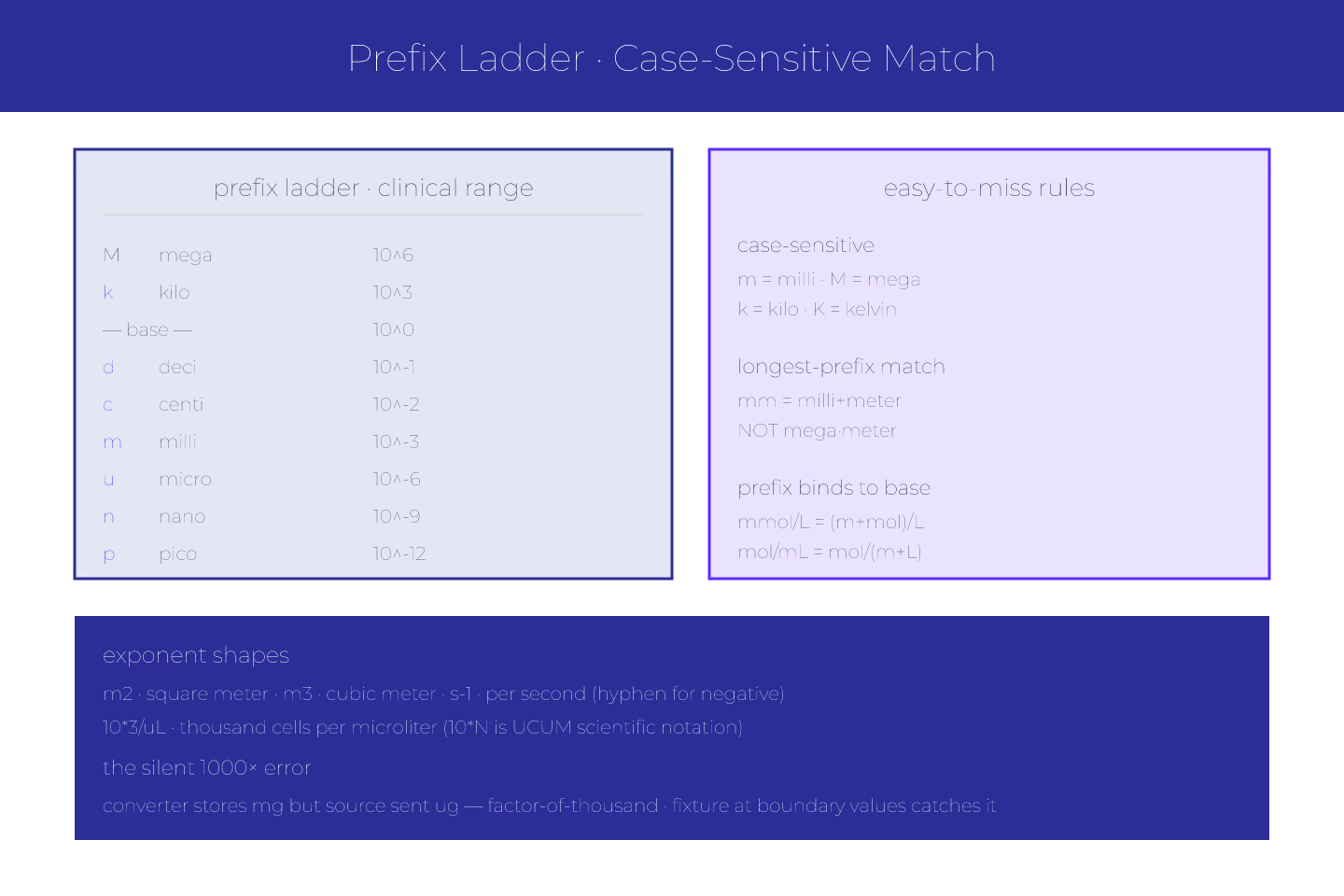
Clinical work rarely leaves the range from p to k. But every prefix is legal, and a stray M where m was intended produces a millionfold error.
Case Sensitivity Matters
m is milli. M is mega. k is kilo. K is kelvin (a base unit, not a prefix).
Case-insensitive matching is a bug. UCUM parsers that lowercase input silently produce wrong prefixes.
For the base pattern, UCUM basics for developers who thought units were simple covers the ground.
Longest-Prefix Match
mm is millimeter, not mega·meter. UCUM parsers should match the longest prefix first, then fall back to shorter ones.
That is a subtle rule. Parsers that match greedily left-to-right without checking the composition can produce the wrong result on ambiguous codes.
Exponents
m2— square meterm3— cubic meters-1— per second (frequency)10*3/uL— thousand cells per microliter
Exponents are unsigned integers unless a hyphen prefixes them. The 10* shape is a UCUM convention for scientific notation without a base unit — used for cell counts, particle counts, and titers.
For the canonical set of units that use exponents, canonical UCUM units the FHIR spec assumes you'll use is the entry.
The Silent Off-By-Prefix
An observation storing mg where the source sent ug — a 1000× error. An observation storing mmol where the source sent umol — a 1000× error. A converter that does not verify prefix mapping between source and target produces these silently.
Every converter should log or expose the prefix mapping it applied. For the testing side, testing UCUM conversion against clinical fixtures covers the pattern.
Compound Units With Prefixes
mmol/L — milli-mole per liter. The prefix binds to the base unit before division. mol/mL — mole per milliliter (prefix binds to L, not mol).
Position matters. m prefixes the base unit it immediately precedes, not the whole expression.
Test With Boundary Values
Prefix errors are easiest to catch at boundary values — 0.001, 1000, 10^6. Test converters at those points; they surface off-by-prefix bugs that a mid-range value would mask.
The Short Version
Case-sensitive. Longest prefix wins. Exponents are unsigned unless hyphenated. 10*N is scientific notation. Prefix position matters in compound units. Test at boundary values. For the base pattern, UCUM basics for developers who thought units were simple is the entry.
Sources
- UCUM canonical specification defining prefix rules and case - UCUM canonical specification defining prefix rules and case sensitivity